
Step outside in New Orleans in August and the air hands you a wet towel. Step into a basement that has been shut up since May and the smell tells you the same story from the other direction. A 50 pint dehumidifier for basement duty is the tool that fixes it, and it is one of the few appliance purchases I tell homeowners to make without agonizing over it.
The agonizing belongs in the setup, not the shopping. Pints per day is a lab number, measured in a warm, sealed room with the humidity cranked up. Your basement is not that room. It has a leaky bulkhead door, a concrete floor that wicks, a water heater venting moisture into the air, and a stairwell that trades air with the rest of the house all day. In real Gulf Coast conditions I cut a pint rating by 30 to 40 percent before I believe a word of it.
Get the drain right, put the machine in the right spot, set the humidistat honestly, and a 50 pint unit will hold a normal basement at 50 percent. Skip those steps and you have bought a loud bucket with a cord.
Why you should trust me
I have been an HVAC technician for 18 years, most of it in Orleans and Jefferson Parish, and I have pulled more moldy drywall out of Louisiana homes than I can count. Mold remediation is not my business. Machines are. I install and service portable dehumidifiers for homeowners, and I have run more than 10 of them through real Gulf Coast summers in my own 1920s shotgun house, where the back rooms have no central air and the humidity does whatever it wants.
Three habits come out of that work. A hygrometer log, so I know what a room was doing before and after I touched it. A watt meter, because energy use is a monthly bill and not a spec sheet line. And a bucket routine, where I weigh or measure the water every unit pulls, because the number on the box and the water in the bucket are two different numbers.
Those habits are what this guide is built on.
How I picked and how I tested
This is a how-to article, not a roundup, so the testing question looks a little different. I have not had this exact Tehanld unit on my bench yet, and I am not going to hand you numbers I did not measure. What I can tell you is how the 50 pint compressor class behaves in a real house, what the specs on this one claim, and exactly what to check in your first week of ownership so you know within seven days whether it is doing its job.
The checks I run on any portable unit, in this order. Does the humidistat agree with my hygrometer, or is it off by 15 percent like most of them. Does the unit return to the humidistat setting after a power blip, or does it restart in fan only. How much water does the tank actually hold before the float trips. Does the hose port gravity-drain without a low spot. And how loud is the compressor at kick-in, because a basement bedroom changes that answer.
You can run all five checks without owning a meter. That matters, because the setup is where these machines are won and lost.
What 50 pints actually means in your basement
The rating is the water the unit can pull out of the air in 24 hours under lab conditions, warm and humid and sealed. A 50 pint machine in a real basement, with real door gaps and a real stairwell, pulls closer to 30 or 35 pints on its best day. That is still a lot of water. It is just not the number on the box.
For a basement in the 500 to 700 square foot range, damp but not flooding, 50 pints is the right class. If your basement is 1,200 square feet, or it is fed by a dirt-floor crawlspace that never dries out, one 50 pint unit will run nonstop and still lose. Two smaller units at opposite ends of a long room beat one big unit in a corner. Nobody wants to hear that they need two machines. I say it anyway, because a single unit that never reaches setpoint is a unit you will resent.
Temperature decides the technology. Compressor units, which is what almost every 50 pint portable is, win in warm air. Desiccant units win in cold basements, below roughly 60 degrees, where a compressor coil frosts and the machine spends half its life in defrost instead of pulling water. If your basement sits at 55 degrees year round, stop shopping for a compressor and go read about desiccant instead. Most reviews ignore that split entirely.
Placement: where the machine actually goes
Middle of the room beats against the wall every single time. Give the unit 6 to 12 inches of clearance on all sides, keep it off drapes and cardboard boxes, and leave the interior doors open so it can reach the whole floor. A dehumidifier in a closed closet dehumidifies the closet.
Hard floor, not carpet, if you have the choice. Carpet holds water and traps the exhaust. Keep the machine out of the traffic path, especially on a stair landing, because a dehumidifier that gets kicked is a dehumidifier that gets unplugged and forgotten. Do not put it on a shelf, and do not box it into a cabinet with a louvered door and call it finished.
Put it near the drain you plan to use, not near the outlet you happen to have. If the only floor drain is on the far side of the basement and the only outlet is behind the washer, you are about to discover that a hose runs downhill and an extension cord does not care. Plan the water first, then the power.
The 50 pint unit I would start with
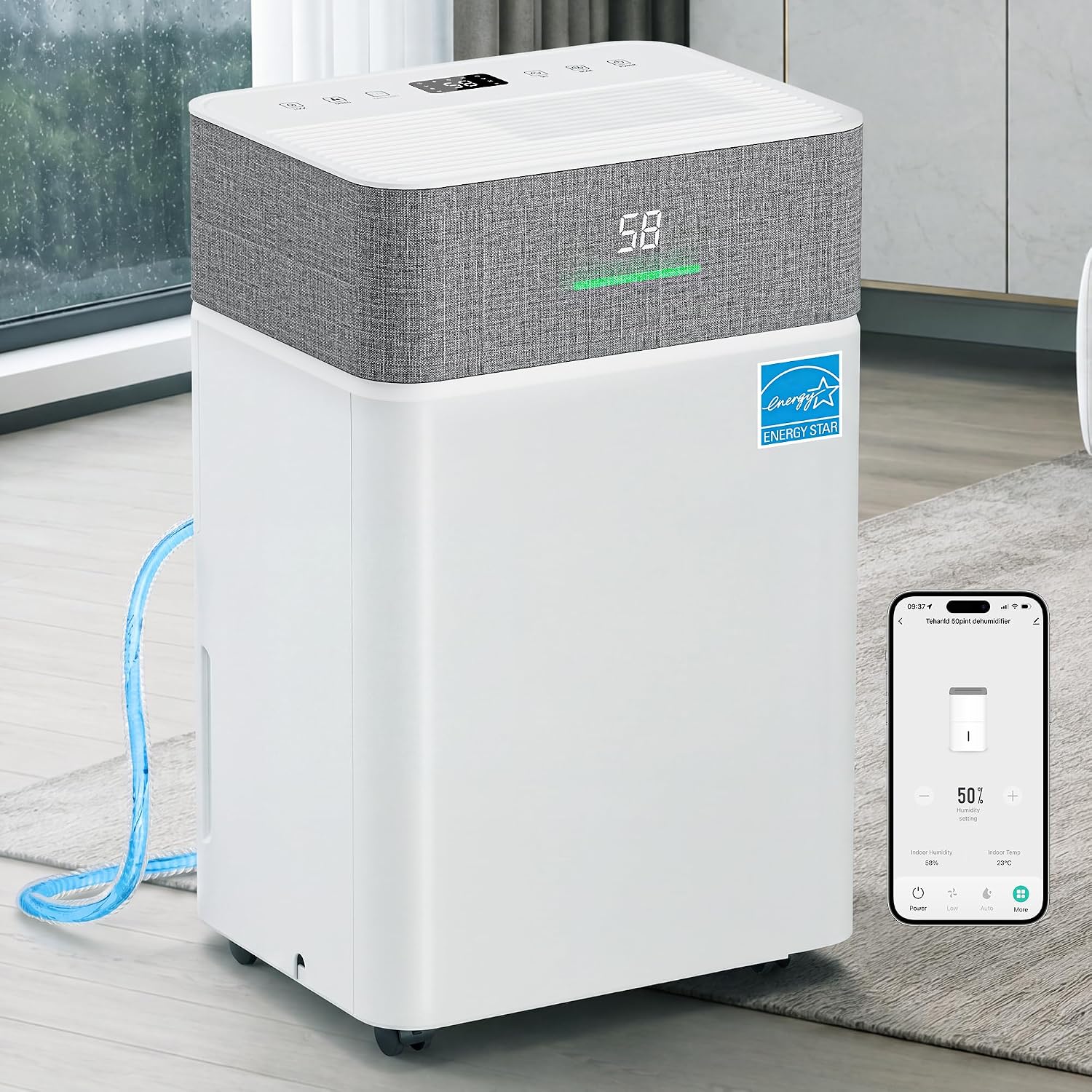
Our pick: Tehanld 50 Pint Dehumidifier for Basement, Energy Star Dehumidifiers
 Visit on Amazon →
Fifty pints is the class I recommend for a normal damp basement, and this is the unit in that class I would start with. It is rated at 50 pints per day, it carries the Energy Star label, and it is built for basement duty rather than a bathroom countertop. Check current Amazon price before you commit, because this class of machine moves around.
The Energy Star label is the part I care about most. A dehumidifier is a compressor and a fan running all summer, and efficiency is the difference between a machine you run and a machine you turn off to save money on the bill. A machine you turn off is not dehumidifying anything.
What I would verify in week one, using the checklist above: the humidistat reading against your own hygrometer, the tank float before the tank is anywhere near full, the hose port with the hose attached and running, and the restart behavior after you kill power at the breaker. Those four checks tell you more than any review, including this one.
Flaws but not dealbreakers: Any 50 pint compressor unit is loud, and this one is no exception. It will not fix a wet basement caused by a gutter dumping against the foundation, and it will not dry out a flooded floor. It is a dehumidifier, not a sump pump and not a waterproofing crew.
Anyone with a damp basement in the 500 to 700 square foot range, or a damp whole-floor situation with a drain available, will get real work out of this machine.
The non-dehumidifier item in this guide
Job-site extra: Wide Jaw Opening Anti-Splash Slanted Nail Clipper,2026 New Fingernail and Toenail Clippers Clippers for Ingrown Nails,Clippers for Thick Nails, Household Slanted Nail Clippers (Orange)
 Visit on Amazon →
I am going to be straight with you. This is not a dehumidifier and it will not pull a drop of water out of your basement. It is in this guide because it came along with the unit, and because I keep one in the truck. Crawling through a crawlspace in a Tyvek suit, catching a thumbnail on a floor joist is a normal Tuesday.
The wide jaw opening is why I like it for a thick nail. The anti-splash lip keeps the clipping from launching across a bathroom floor, and the slanted head gets under an ingrown corner without digging at it. Check current Amazon price. It is a household tool, not a job-site tool, but it does its one job and it does it without a trip to the store.
Flaws but not dealbreakers: The jaw is wide enough that a thin nail can slide toward the hinge, so start the cut with the tip. The orange handle is loud in a drawer if you care about that sort of thing.
Anyone ordering a dehumidifier and dealing with a nail that needs attention will find it useful. Anyone looking for moisture control should keep scrolling.
The setup, step by step
Step one: log the room before you plug anything in. Put a hygrometer in the basement and leave it 24 hours. You need a starting number, not a guess. If it reads 70 percent or higher, plan on a hose and plan on the machine running most of the day.
Step two: level the machine and give it air. Hard floor, 6 to 12 inches off every wall, nothing stacked on top, interior doors open. A tilted unit sloshes, and a sloshing tank trips its float early, which means the machine shuts off before the water is actually high.
Step three: decide tank or hose before the first fill. Tank is fine for a bedroom. For a basement or any unit that runs all summer, run the hose. If you have a floor drain or a sump pit lower than the unit, gravity does the work for free.
Step four: run the hose downhill the whole way. Every inch of that hose needs to slope toward the drain. No loops, no uphill sections, no coiling the extra length behind the unit. Water sits in a low spot, the unit backs up into the tank, and then it shuts off at the worst hour. Zip tie it and check it after a week.
Step five: set the humidistat to 50 to 55 percent. Not 30, and not continuous. Below 50 is uncomfortable dry for a living space, and the compressor will run itself ragged chasing a number it cannot hold with a leaky bulkhead. If you can smell mold, set 45 and fix the water source that is feeding it.
Step six: let it run 24 hours, then measure. Read the hygrometer and pour the tank into a measuring bucket, or weigh it. That is your real pints per day, in your house, in your weather. Compare it to the box rating and you will understand the 30 to 40 percent cut firsthand.
Step seven: close the envelope. Weatherstrip the bulkhead door, fix the gutter that dumps next to the foundation, cover the crawlspace vent you forgot about. A dehumidifier is fighting the outdoors, and every gap is a hole in the bucket.
Step eight: test the restart. Kill power at the breaker, wait a minute, restore it. The unit should come back to the humidistat setting. If it comes back in fan only, you will find out during a thunderstorm week. Note it, work around it, or send it back while you still can.
Maintenance and the failures I see
Humidistat drift is the big one. Most of them are off, sometimes by 15 percent, and that is why you own a hygrometer. Check the two against each other quarterly. If the unit thinks the room is 45 when your hygrometer says 60, you are running a machine that will never satisfy itself.
Clean or rinse the filter monthly during the wet season. A clogged filter costs you pints and raises coil temperature. Vacuum the coil fins gently with a brush attachment and do not bend them. Wash the tank and float with warm water and a splash of vinegar, because mineral film makes a float stick, and a stuck float either floods the machine or shuts it off early.
In a cold basement, watch for frost on the coil. If it ices up, the machine is spending its run time in defrost, and that is a desiccant job, not a compressor job. Before you store the unit for the winter, empty it, run it a few hours in a warm room to dry the coil, and leave the tank off.
The competition and why it lost
A desiccant dehumidifier is the right answer for a basement that stays under 60 degrees, because it holds its capacity where a compressor frosts. It costs more to run in warm air, so it is the wrong answer for a Louisiana summer basement. Temperature decides, not brand loyalty.
A window AC with a dry mode is sometimes enough. For one damp bedroom in July, a window unit that cools and dehumidifies at the same time can beat a portable dehumidifier, because the room is hot anyway. It is not a basement answer, and it is not a winter answer.
Smart features lose on their own. The app is a support call generator. I have reset more Wi-Fi modules than compressors, and a unit that will not reconnect is a unit that will not run on schedule.
And bigger is not automatically better. A 70 pint unit in a small, cool basement short-cycles, pulls less water than the rating suggests, and wears out faster. Match the machine to the room, not to the box with the biggest number.
What this all costs
I am not going to quote prices, because they move and you can see the current number on the listing. Check current Amazon price on the unit itself before you decide.
The costs that actually matter are the ones after the purchase. Running a compressor dehumidifier 24 hours a day in July is a real line on your utility bill. Do the math the way I do it: watts on the label, times hours of run time, times your utility's rate. That is your monthly number, and it is the reason the Energy Star label matters more than any app feature.
The cheap parts of this setup are the hose, the zip ties, and the hygrometer. The expensive part is doing nothing about the water source and letting the machine run all summer against an open door. A dehumidifier that never reaches setpoint is the most expensive one you can own, no matter what you paid for it.
Set the drain, level the machine, set an honest humidistat, and measure the bucket once. Then you know what you actually bought. That is the whole job.